Rhinoceros oryctes - Rhino Beetle About
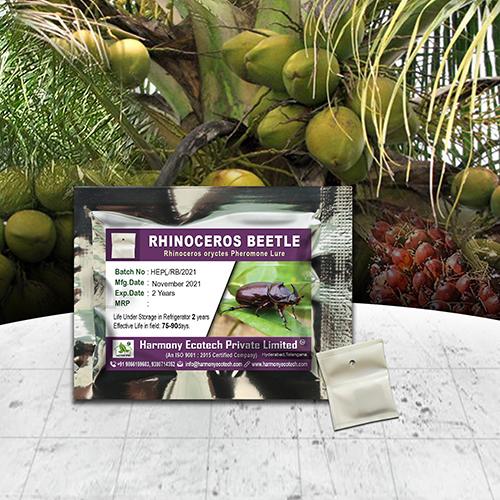
Rhinoceros oryctes - Rhino Beetle is mainly a pest of coconut and oil palms. The beetle damage palms by boring into the centre of the crown, injuring the young growing tissues and feed on the exuded sap. This product is intended for use as attractant of Rhino beetle in Coconut and oil palm Plantations, in order to trap them for monitoring and mass trapping. Rhinoceros oryctes - Rhino Beetle can grow up to six inches.
| Product Name |
Rhino Beetle Pheromone Lure |
| Mode of Action |
Aggregation Pheromone |
| Active Ingredient |
Ethyl 4-Methyl Octanoate |
| Dosage |
400 mg per dispenser / lure |
| Product Description |
Polyethylene pouch containing Ethyl 4-Methyl Octanoate loaded in wood Block / Porous PP block. |
| Active Life |
Up to 3 months (depending on climatic conditions) |
| Shelf Life |
2-3 years if stored according to the standard protocol. |
Unique Features of Rhino BeetleThe Rhinoceros oryctes is easily identified by its characteristic horn and sizable body, making it distinguishable from other beetles. Its moderate mobility and adaptability to various environments allows for flexible application in agricultural settings.
Storage and Handling GuidelinesTo maintain beetle health, keep them in a well-ventilated box and manage temperature within 2035C. When releasing beetles into the field, always wear gloves as a handling precaution to ensure safe and hygienic operations.
Agricultural BenefitsRhino Beetles contribute to natural pest control by feeding on decaying organic matter and targeting the breeding sites of crop-damaging pests. Their high reproduction rate ensures prolonged effectivity, protecting coconut, oil palm, and sugarcane plantations efficiently.
FAQs of Rhinoceros oryctes - Rhino Beetle:
Q: How should Rhinoceros oryctes be stored before field release?
A: Keep Rhino Beetles in a well-ventilated box under temperatures between 20 and 35C to ensure their health and viability until application in agricultural fields.
Q: What is the process for releasing Rhino Beetles in plantations?
A: Release adult beetles directly onto target crops like coconut, oil palm, or sugarcane. Always wear gloves during handling to maintain safety standards and prevent accidental harm.
Q: When is the optimal time to introduce Rhino Beetles to control pests in crops?
A: Rhino Beetles can be introduced whenever pest activity is noticed, ideally during the crops active growing season or when decaying matter and pest breeding sites become evident.
Q: Where are Rhino Beetles most beneficial for pest control?
A: These beetles are particularly effective in coconut, oil palm, and sugarcane plantations, where they disrupt pest breeding cycles by feeding on organic debris and reducing pest populations.
Q: What benefits do Rhino Beetles provide to agricultural environments?
A: By feeding on decaying matter and breeding sites, Rhino Beetles naturally reduce pest populations and contribute to healthier crop yield without chemical intervention.
Q: How can Rhino Beetles be identified?
A: Adult Rhinoceros oryctes feature a distinctive horn on their head and a dark brown to black exoskeleton, and typically measure 4060 mm in length.





 08045477267


 Send Inquiry


 Send Inquiry


 English
 Spanish
 French
 German
 Italian
 Chinese (Simplified)
 Japanese
 Korean
 Arabic
 Portuguese