Spodoptera litura - Oriental Leaf Worm About
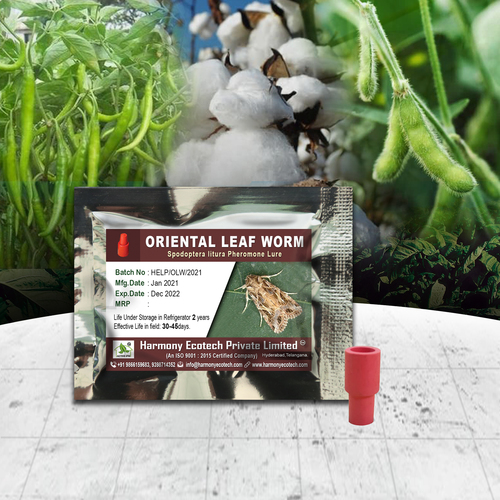
The offered Spodoptera litura - Oriental Leaf Worm is made available by us for use in the various commercial and agricultural applications. The Leaf worm is considered to be one of the most damaging insect pests of agricultural crops and is a generalist defoliator. It feeds on over 120 plant species, including various cash, food, and ornamental crops. The lure helps in keeping the Spodoptera litura - Oriental Leaf Worm away from the crops.
Specification
|
Product Name
|
Spodoptera litura Pheromone Lure
|
|
Mode of Action
|
Attractant Pheromone
|
|
Active Ingredient
|
Z9,E11-Tetradecadienyl acetate,
Z9,E12-Tetradecadienyl acetate
|
|
Dosage
|
3 mg per dispenser / lure
|
|
Product Description
|
Met pet pouch containing Z-9,E-11-Tetradecadienyl acetate & Z9, E-12-Tetradecadienyl acetate blend loaded in silicon rubber septa.
|
|
Active Life
|
Upto 30-45 days depending on climatic conditions.
|
|
Shelf Life
|
2 years if stored according to the standard protocol.
|
Major Crop Pest with Wide Host RangeThe Oriental Leaf Worm attacks a diverse array of over 112 plant species, including key crops like cotton, soybean, groundnut, tobacco, vegetables, and ornamentals. Due to its polyphagous nature and wide host range, it is one of the most economically significant pests in tropical and subtropical agricultural systems. Intensive monitoring is crucial to prevent heavy losses.
Identification and Life CycleLarvae of Spodoptera litura feature four pairs of tubercles on the dorsal side of the 8th abdominal segment, and adult moths exhibit distinctively marked forewings. The insect can complete its life cycle in 30-40 days within optimal temperatures of 20C to 35C, producing multiple generations annually, thereby increasing infestation risk if unchecked.
Integrated Pest Management ApproachesA combination of biological control agents, pheromone traps, chemical insecticides, and mechanical removal is recommended for effective management. Field monitoring and early detection play vital roles in minimizing crop damage, supporting sustainable agricultural practices, and reducing the pests economic impact.
FAQs of Spodoptera litura - Oriental Leaf Worm:
Q: How can I identify an infestation of Spodoptera litura in my crops?
A: Look for irregular holes in leaves, skeletonized foliage, and feeding damage on young shoots and bolls. Larvae are pale green to brown with four pairs of tubercles on the 8th abdominal segment, while adult moths have mottled brown-grey wings with distinct markings.
Q: What crops are most commonly affected by the Oriental Leaf Worm?
A: Spodoptera litura targets a wide range of crops including cotton, soybean, groundnut, tobacco, several vegetables, ornamentals, and over 112 plant species, making it a highly significant pest for many agricultural producers in Asia.
Q: When is Spodoptera litura most likely to cause damage to crops?
A: The larval stage causes the maximum damage as larvae feed heavily on foliage and young shoots. Their lifecycle duration is 3040 days, with multiple generations per year, especially thriving between 20C and 35C.
Q: Where is Spodoptera litura commonly distributed?
A: This pest is widespread throughout Asia, including India, China, and Southeast Asian countries, notably in tropical and subtropical agricultural regions.
Q: What process should be followed for effective control of Spodoptera litura?
A: Integrated pest management is recommended, which includes field monitoring, biological control using natural predators or parasitoids, pheromone traps for adult monitoring, selective insecticide applications, and manual removal of larvae to reduce populations.
Q: How do pheromone traps help in managing Spodoptera litura?
A: Pheromone traps are used for early detection and monitoring of adult moth populations. This helps in timely intervention before the larvae cause significant damage to crops, making chemical and biological control measures more effective.
Q: What benefits does early detection and integrated management offer against this pest?
A: Early detection, combined with integrated management practices, helps in reducing the incidence of heavy infestations, minimizes crop losses, and supports sustainable, environmentally friendly agricultural production by reducing reliance on chemical insecticides.





 08045477267


 Send Inquiry


 Send Inquiry


 English
 Spanish
 French
 German
 Italian
 Chinese (Simplified)
 Japanese
 Korean
 Arabic
 Portuguese